Let’s be honest: trying to keep up with digital marketing can feel like trying to run up a down escalator.
Just when you think you’ve mastered a platform’s algorithm, they change the code. A new social media app explodes overnight, or a new AI tool drops, and suddenly everyone is telling you that everything you knew yesterday is obsolete.HERE COMES THE IMPORTANCE THE DIGITAL MARKETING SKILLS
But here is the industry’s open secret: the core of great marketing has not changed in a hundred years. Platforms are just plumbing. Marketing is, and always has been, about human psychology—understanding what someone needs, where they hang out, and how to talk to them in a way that makes them feel heard.
If you want to build a career-proof, high-impact marketing toolkit, you don’t need to chase every shiny object. You just need to master these eight core pillars.
The Digital Marketing Skills Matrix
1. Video Marketing (The Hook-Story-Offer Framework)
Video is no longer a “nice-to-have” add-on; it is how the internet speaks. But making great video isn’t about expensive cameras or Hollywood lighting. It’s about understanding pacing and attention.The most critical framework to master is Hook-Story-Offer:
- The Hook (First 3 seconds): You have to stop the thumb scroll. Don’t start with “Hi, my name is…” Start with a bold question, a shocking stat, or an visual pattern interrupt.
- The Story (The next 15–60 seconds): Deliver on the promise of the hook. Keep it fast, raw, and highly visual.
- The Offer (The ending): Tell them exactly what to do next. “Link in bio,” “Drop a comment,” or “Subscribe.”
2. Search Engine Optimization (SEO)
Ignore anyone who tells you SEO is dead. As long as people have questions, they will use search engines to find answers. However, SEO has shifted from “gaming the system” to “serving the human.”
Modern SEO is about two things: Topical Authority and User Intent. Instead of writing ten short, keyword-stuffed articles, you are much better off writing one incredibly thorough, deeply helpful resource that covers a topic from every angle. When you write for the human reader first, search engine algorithms naturally reward you.
3. Search Engine Marketing (SEM)
While SEO is a marathon, SEM (Paid Search) is a sprint. This is the skill of buying highly targeted real estate at the very top of search engine results pages (like Google Ads).
To succeed in SEM, you have to master:
- Intent Matching: Bidding on keywords that show a high readiness to buy (e.g., “best project management software for agencies”) rather than just general curiosity (“what is project management”).
- Psychological Copywriting: Writing headlines that mirror the searcher’s exact frustration and promise an immediate cure.
- Ad Spend Math: Knowing your numbers so you’re not spending $ 50 to acquire a customer who only spends $ 20.
4. Content Marketing
If paid ads are an invitation to a party, content marketing is the hospitality that makes people want to stay. It is the art of building a relationship by giving away your best secrets for free.Whether you are writing blog posts, crafting newsletters, or publishing case studies, the goal is simple: solve your audience’s problems before you ask for their money. When you consistently show up with high-value, fluff-free advice, you transition from a “company trying to sell something” to a “trusted industry resource.”
5. Data & Analytics
You don’t need to be a math genius to succeed in marketing, but you absolutely cannot afford to make decisions based on “gut feelings.”
Move past vanity metrics (like page views, likes, or impressions) and learn to track the numbers that actually keep the lights on:
- Customer Acquisition Cost (CAC): Exactly how much money does it cost to get one new customer?
- Customer Lifetime Value (LTV): How much money does an average customer spend with you over their entire relationship?
- Return on Ad Spend (ROAS): For every dollar you put into paid channels, how many dollars come back out?

6. AI & Automation
Here is the truth about artificial intelligence: AI isn’t going to take your job. But a marketer who knows how to use AI is going to take the job of a marketer who doesn’t.
Think of AI as your super-intern. Use it to build initial article outlines, summarize long research papers, brainstorm angle ideas, or write basic code snippets. But never let it have the final word. The human touch—your unique perspective, personal stories, empathy, and style—is what keeps content from sounding like cold, boring machine-speak.
7. Design Thinking & User Journeys
Before you write a single line of copy or design a landing page, you have to map the user journey.
Design thinking means stepping completely out of your own shoes and into your customer’s.
- Where do they first find out about you?
- What doubts pop into their head when they look at your pricing?
- Why might they abandon their shopping cart?
By mapping these touchpoints with empathy, you can design smooth, intuitive pathways (funnels) that guide users naturally from complete strangers to loyal brand advocates.
8. Social Media & Email Marketing
These are two sides of the same relationship-building coin, but they serve very different purposes:
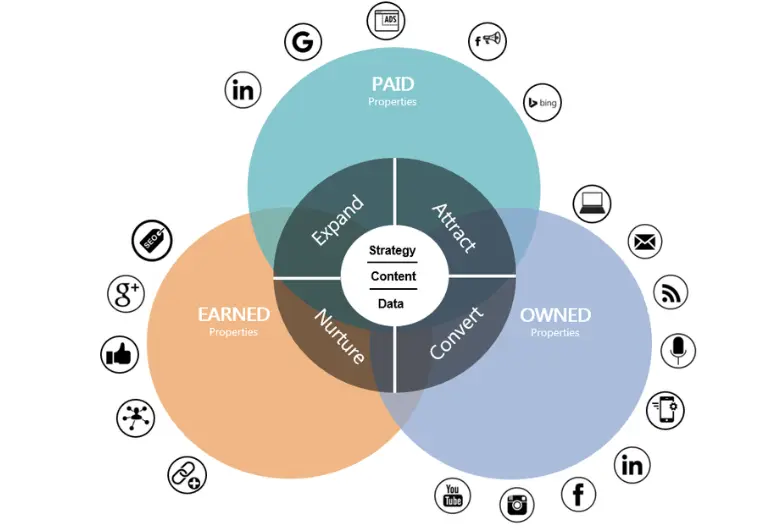
- Social Media (Rented Land): Platforms like Instagram, LinkedIn, and YouTube are amazing for discovering new audiences and building a community. But you don’t own your followers. If an algorithm changes tomorrow, your reach can drop to zero.
- Email Marketing (Owned Land): Your email list is yours. No algorithm can stand between you and your subscribers. Use social media to introduce yourself, but work hard to move those relationships over to your email list where you can nurture them directly.
The Takeaway: Aim to Be a “T-Shaped” Marketer
No one can be a world-class expert in all eight of these disciplines. If you try, you’ll end up spread too thin to be effective.
Instead, strive to be a T-shaped marketer:
- Develop a broad, fundamental understanding of all eight areas (the horizontal bar of the T). This allows you to speak the language of other specialists and see how the whole ecosystem fits together.
- Choose one or two areas to dive incredibly deep into (the vertical bar of the T). Become the absolute go-to expert in those niches.
Which of these skills are you going to focus on first? Let’s map out a study plan in the comments below!